One of the best ways to become a better public speaker is to study great public speakers.
As I’ve been working on my own speaking, I’ve spent more time watching great talks and paying attention not just to what the speaker says, but how they say it. How do they open? How do they tell stories? How do they use humor? How do they structure an idea? And what keeps an audience engaged for 10, 15, or 20 minutes?
TED and TEDx talks are particularly interesting to study because speakers have a limited amount of time to communicate an idea and capture an audience. The best talks often combine storytelling, structure, delivery, emotion, humor, visuals, and a clear central message.
So I put together this list of 100 talks to study as I work on becoming a better speaker.
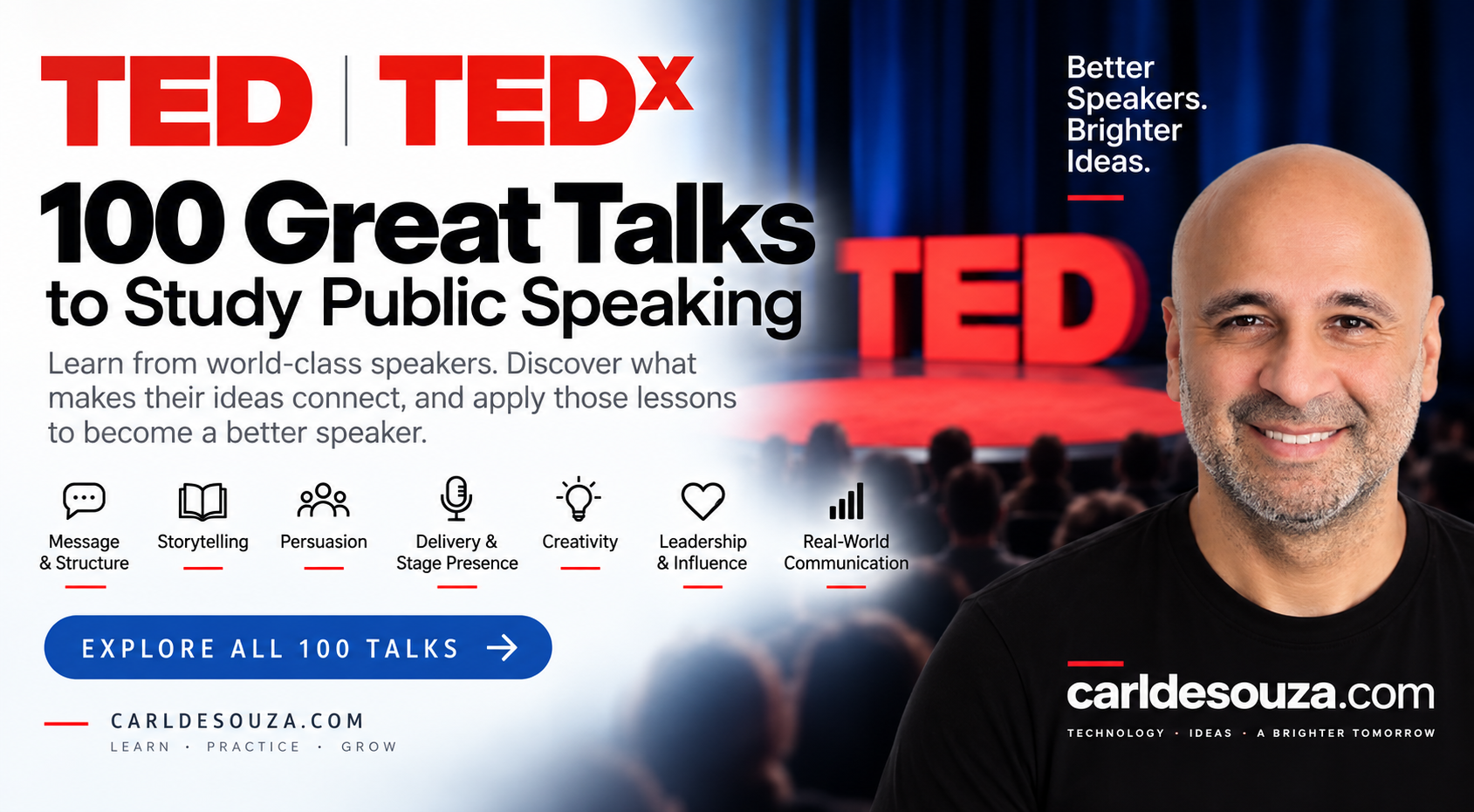
This isn’t intended to simply be a list of popular TED Talks. I’ve organized the talks around different aspects of communication — from speaking fundamentals and storytelling to persuasion, stage presence, humor, conversation, and leadership.
For each talk, I’ve also included what I plan to study while watching it.
My goal is to work through the list, take notes, experiment with these techniques in my own speeches, and share what I learn along the way.
If you’re working on becoming a better speaker too, you can use the list as a public speaking curriculum: watch the talks, study the speakers, and pay attention to what makes their ideas connect with an audience.
Let’s start with the fundamentals.
Phase 1 — Message & Speaking Fundamentals
Phase 2 — Storytelling
Phase 3 — Structure, Ideas & Persuasion
Phase 4 — Delivery & Stage Presence
Phase 5 — Humor & Audience Connection
Phase 6 — Conversation & Leadership
| # | Talk | Speaker | Type | What to Study | Duration |
|---|---|---|---|---|---|
| 74 | 10 Ways to Have a Better Conversation ↗ | Celeste Headlee ↗ | TEDx | Conversation | 11:44 |
| 75 | Want to Help Someone? Shut Up and Listen! ↗ | Ernesto Sirolli ↗ | TEDx | Listening | 17:09 |
| 76 | Listen, Learn… Then Lead ↗ | Stanley McChrystal ↗ | TED | Leadership | 15:38 |
| 77 | Lead Like the Great Conductors ↗ | Itay Talgam ↗ | TED | Metaphor | 20:51 |
| 78 | How to Manage for Collective Creativity ↗ | Linda Hill ↗ | TEDx | Leadership | 17:16 |
| 79 | What It Takes to Be a Great Leader ↗ | Roselinde Torres ↗ | TED | Executive speaking | 9:20 |
| 80 | How to Turn a Group of Strangers Into a Team ↗ | Amy Edmondson ↗ | TED | Psychological safety | 12:57 |
| 81 | The Way We Think About Work Is Broken ↗ | Barry Schwartz ↗ | TED | Challenging assumptions | 8:52 |
| 82 | The Way We Think About Charity Is Dead Wrong ↗ | Dan Pallotta ↗ | TED | Persuasive argument | 18:48 |
| 83 | Learning From Leadership’s Missing Manual ↗ | Fields Wicker-Miurin ↗ | TED | Leadership stories | 16:46 |
| 84 | The Gift and Power of Emotional Courage ↗ | Susan David ↗ | TED | Emotional connection | 16:48 |
Phase 7 — Advanced Persuasion, Explanation & Ideas
How I Plan to Use This List
The goal isn’t just to watch 100 talks. It’s to study them deliberately. For each talk, I plan to focus on the communication technique highlighted in the What to Study column and take notes on what the speaker actually does.
That might mean studying the first 60 seconds of a talk, noticing how a story is structured, listening for changes in pace and vocal variety, or looking at how a speaker transitions from one idea to the next.
Then comes the most important part: trying the techniques. The real value comes from taking an idea from a great speaker, experimenting with it in a speech or presentation, and deciding what works for your own speaking style.
What I’ll Be Looking For
The Goal: Study, Practice, Improve
Great speaking can look effortless, but there is usually a lot happening underneath the surface. A story has been chosen for a reason. A pause has been placed at the right moment. An idea has been simplified. A joke creates connection. A closing line gives the audience something to remember.
Working through these talks gives us a chance to slow those moments down and learn from them.
I’ll continue updating this list as I study the talks and learn more about public speaking and communication. If you’re working on your speaking too, pick a phase, choose a talk, and start studying.
If you’re preparing for an important speech or presentation and would like some one-on-one help, I also offer public speaking coaching and presentation feedback. Get in touch → carl@carldesouza.com.

Explore AI, agents & Microsoft technology.
I share practical ideas, tutorials, and videos about AI, AI agents, Microsoft technologies, and the Power Platform.
Subscribe on YouTube →